研究成果
Jan, 2017
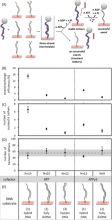
DNA topology is thought to affect DNA enzyme activity. The helical structure of duplex DNA dictates the change of topological states during strand separation when DNA is constrained. During the repair of DNA double-stranded breaks, the RecA nucleoprotein filament invades DNA and carries out consecutive strand exchange reactions coupled with duplex DNA strand separation. It has been suggested that torsional strain could be generated and its accumulation could inhibit strand exchange. We used hairpin and nicked DNA substrates to test how torsional strain alters the RecA-mediated strand exchange efficiency. Single-molecule tethered particle motion (TPM) experiments showed that torsionally constrained hairpin DNA substrates returned nearly no successful strand exchange events catalyzed by...

Jan, 2017
Background:
Hair follicle is miniorgan constituted by keratinocytes and its distinctive mesenchyme of dermal papilla. Its aging is characterized by organ atrophy and impaired stem cell activation and differentiation. The contribution of dermal papilla to hair follicle aging change is not well understood.
Objective:
This work was aimed at exploring the possible role of premature dermal papilla senescence in the pathogenesis of hair follicle aging.
Methods:
Dermal papilla cells were challenged with H2O2 to induce premature senescence and the proliferation, apoptosis, gene expression and protein secretion were characterized. Its effect on epithelial-mesenchymal interaction was analyzed by co-culture in vitro and implantation of protein-coated beads in vivo.
Result...
Mar, 2016
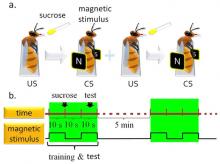
Honey bees have the ability to detect the Earth’s magnetic field, and the suspected magnetoreceptors are the iron granules in the abdomens of the bees. To identify the sensing route of honey bee magnetoreception, we conducted a classical conditioning experiment in which the responses of the proboscis extension reflex (PER) were monitored. Honey bees were successfully trained to associate the magnetic stimulus with a sucrose reward after two days of training. When the neural connection of the ventral nerve cord (VNC) between the abdomen and the thorax was cut, the honey bees no longer associated the magnetic stimulus with the sucrose reward but still responded to an olfactory PER task. The neural responses elicited in response to the change of magnetic field were also recorded at the VNC...
Feb, 2016
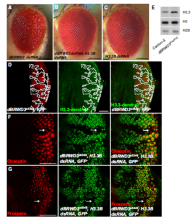
Many causal mutations of intellectual disability have been found in genes involved in epigenetic regulations. Replication-independent deposition of the histone H3.3 variant by the HIRA complex is a prominent nucleosome replacement mechanism affecting gene transcription, especially in postmitotic neurons. However, how HIRA-mediated H3.3 deposition is regulated in these cells remains unclear. Here, we report that dBRWD3, the Drosophila ortholog of the intellectual disability gene BRWD3, regulates gene expression through H3.3, HIRA, and its associated chaperone Yemanuclein (YEM), the fly ortholog of mammalian Ubinuclein1. In dBRWD3 mutants, increased H3.3 levels disrupt gene expression, dendritic morphogenesis, and sensory organ differentiation. Inactivation of yem or H3.3 remarkably...
Feb, 2016
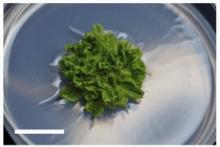
Bryophytes (liverworts, hornworts and mosses) comprise the three earliest diverging lineages of land plants (embryophytes). Marchantia polymorpha, a complex thalloid Marchantiopsida liverwort that has been developed into a model genetic system, occupies a key phylogenetic position. Therefore, M. polymorpha is useful in studies aiming to elucidate the evolution of gene regulation mechanisms in plants. In this study, we used computational, transcriptomic, small RNA and degradome analyses to characterize microRNA (miRNA)-mediated pathways of gene regulation in M. polymorpha. The data have been integrated into the open access ContigViews-miRNA platform for further reference. In addition to core components of the miRNA pathway, 129 unique miRNA sequences, 11 of which could be classified into...
Nov, 2015
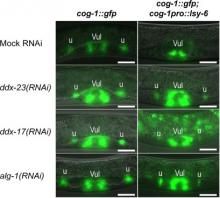
Primary microRNAs (pri-miRNAs) are cleaved by the nuclear RNase III Drosha to produce hairpin-shaped precursor miRNAs (pre-miRNAs). In humans, this process is known to be facilitated by the DEAD-box helicases p68 (DDX5) and p72 (DDX17). In this study, we performed a candidate-based RNAi screen in C. elegans to identify DEAD/H-box proteins involved in miRNA biogenesis. In a let-7(mg279) sensitized genetic background, knockdown of a homolog of yeast splicing factor Prp28p, DDX-23, or a homolog of human helicases p68 and p72, DDX-17, enhanced let-7 loss-of-function phenotypes, suggesting that these helicases play a role in let-7 processing and/or function. In both ddx-23(RNAi) and ddx-17(RNAi), levels of mature let-7 were decreased while pri-let-7 was found to accumulate, indicating that the...
Mar, 2015
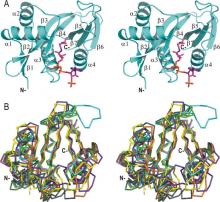
Nα-acetyltransferases (Nats) possess a wide range of important biological functions. Their structures can vary according to the first two residues of their substrate. However, the mechanisms of substrate recognition and catalysis of Nats are elusive. Here, we present two structure of Sulfolobus solfataricus Ard1 (SsArd1), a member of the NatA family, at 2.13 and 1.84 Å. Both structures contain coenzyme A, while the latter also contains a substrate-derived peptide. Sequential structure-based mutagenesis revealed that mutations of critical residues for CoA binding decreased the binding affinity of SsArd1 by 3 ~ 7-fold. Superimposition of SsArd1 (NatA) with human Naa50p (NatE) showed significant differences in key residues of enzymes near the first amino-acid position of the substrate...
Jan, 2015
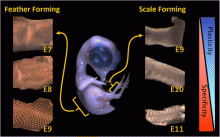
Background: Regional specificity allows different skin regions to exhibit different characteristics, enabling complementary functions to make effective use of the integumentary surface. Chickens exhibit a high degree of regional specificity in the skin and can serve as a good model for when and how these regional differences begin to emerge.
Results: We used developing feather and scale regions in embryonic chickens as a model to gauge the differences in their molecular pathways. We employed cosine similarity analysis to identify the differentially regulated and co-regulated genes. We applied low cell techniques for expression validation and chromatin immunoprecipitation (ChIP)-based enhancer identification to overcome limited cell availabilities from embryonic chicken skin.
We...
Jan, 2015
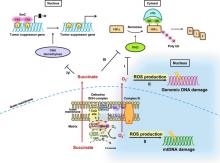
AIMS: Mitochondrial succinate dehydrogenase (SDH) is an essential complex of the electron transport chain and tricarboxylic acid cycle. Mutations in the human SDH subunit D frequently lead to paraganglioma (PGL), but the mechanistic consequences of the majority of SDHD polymorphisms have yet to be unraveled. In addition to the originally discovered yeast SDHD subunit Sdh4, a conserved homolog, Shh4, has recently been identified in budding yeast. To assess the pathogenic significance of SDHD mutations in PGL patients, we performed functional studies in yeast.
RESULTS: SDHD protein expression was reduced in SDHD-related carotid body tumor tissues. A BLAST search of SDHD to the yeast protein database revealed a novel protein, Shh4, that may have a function similar to human SDHD and yeast...